

Our impact
From sky to survival – NHS helipads see 30,000 landings
A study by Professor Sir Keith Porter, Emeritus Professor of Clinical Traumatology, University of Birmingham.
Winston Churchill once said, “It is wise to look forward but few can see beyond the horizon.” The HELP Appeal certainly has that vision with its support to fund on-site hospital helipads, critical care cars and other emergency response vehicles.
To achieve a gold standard, the care of injured and medically unwell patients requires effective first aid, robust clinical assessment with appropriate timely interventions and prompt transfer to hospital. For 15 years the HELP Appeal has played a key role in helping meet some of these objectives.
Helicopter Emergency Medical Services (HEMS) have the ability to deliver Critical Care Teams at or close to the side of a patient and then to transport them to the most appropriate hospital for their clinical needs, in the case of injury usually a Major Trauma Centre. Any secondary land ambulance transfer, because of off-site landing sites, delays immediate access to hospital services which includes CT scanning and life saving surgery. Minutes count particularly for patients with life threatening bleeding where the extra journey time can make the difference between life and death.
The HELP Appeal by fully funding or part funding on-site helipads helps facilitate the prompt delivery of patients directly into the Emergency Department with a trolley-push from the landing site. The HELP Appeal plays its part in the often quoted mantra “Right patient to the right hospital by the right means (of transport) in the right time”.

Photo: Work on construction of a new Helipad for Dorset County Hospital
Professor Tim Coats, Professor of Emergency Medicine and former Chairman of the Trauma Audit and Research Network (TARN) has this to say about helipads:
“When I was looking after a sick patient as part of the helicopter crew I was always so relieved when the hospital had a helipad within trolley-pushing distance as I knew that we could speed the patient on to definitive hospital care. With out a helipad the coordination with the ambulance service can lead to delay and makes a frontline ambulance unavailable for immediate response to 999 calls. The doctors and paramedics in HEMS operations are convinced that a hospital helipad is an integral part of the chain of survival which leads to good patient outcomes”
This opinion is reinforced by Alfie Day, Head of Operations at The Children’s Air Ambulance (TCAA):
“Our clinical patient teams are relieved to know that a hospital helipad has a trolley push and a ground ambulance is not required. There have been multiple times where delays have been caused by the complexities in arranging a ground ambulance”.
It is well recognised that many significant road traffic collisions and acts of violence occur after dark where only a small number of HEMS services have night flying capacity and then only to pre-determined landing sites. To provide access to 24 hour Critical Care Teams and an alternative to helicopters during inclement weather the HELP Appeal has funded a number of bespoke critical care vehicles and in some cases contributed to the cost of medical equipment.
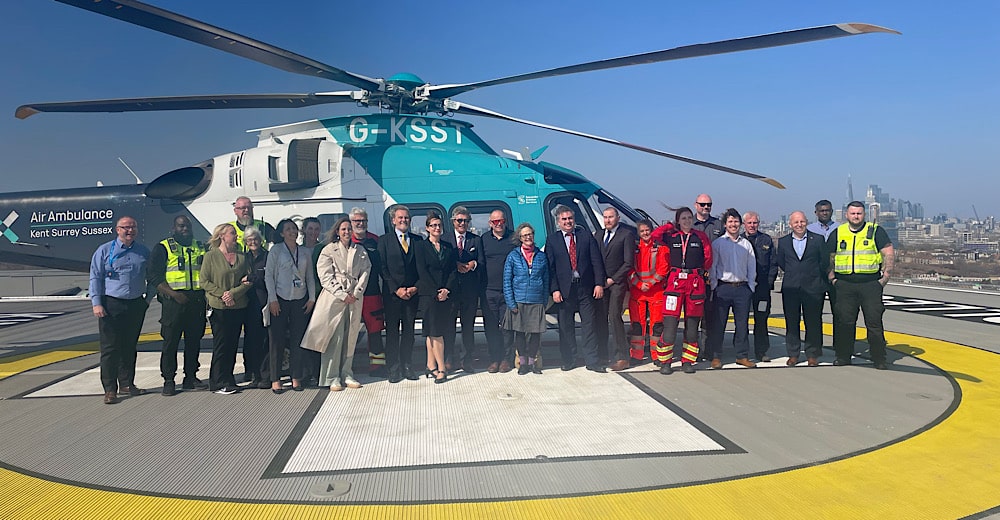
Photo: Marking the 2,000th patient to be flown in to King’s College Hospital
In congratulating the HELP Appeal on its 15th anniversary Hanna Sebright CEO of the Midland Air Ambulance Charity thanked the HELP Appeal for its generous and sustained support:
“Your generous grant funding has played a critical role in enabling ongoing investment in our advanced critical capabilities-both by air and land- ensuring our crews are equipped to deliver the very best in pre-hospital care. Thanks to your unwavering commitment weve been able to enhance our helicopter and rapid response vehicle fleets, upgrade our airbases and hangar facilities and invest in specialist equipment that empowers our clinicians to save lives every day. These improvements have significantly strengthened our reach and resilience, helping us serve communities across six Midland counties more effectively than ever before. We are truly grateful for your continued partnership in our life saving mission.”
Lindsay Boswell acting CEO of Air Ambulance UK on behalf of the Air Ambulance charities they represent said:
“The work of an air ambulance is focused on getting high quality clinical care to a trauma patient as fast as possible. Time is critical and literally every minute can be the difference between tragedy and recovery. The focus on helipads is a critical part of the success of the UKs air ambulances and the creation of 32 new helipads alongside the upgrading of a further 23 is truly extraordinary. So many air ambulances themselves have benefitted by having state of the art helipads funded by The HELP Appeal. Equally important is the support to the NHS and Major Trauma Centres in particular to facilitate the rapid transfer of a casualty after receiving immediate skilled clinical care to a hospital where the optimal recovery hopefully takes place.
“There are literally thousands of people and many thousands of relatives and friends of those who have suffered trauma who owe their future to the hundreds of thousands of donors who have funded the HELP Appeal. There is much more work to do and it is a huge comfort to know that such a professional and competent organisation is supporting the work of the air ambulance community,”

Photo: Queen Elizabeth University Hospital Helipad, Glasgow.
The HELP Appeal has also made funds available to help provide vehicles which allow appropriately trained and accredited doctors and nurses to be solo responders particularly in rural and remote locations where it can take a land ambulance a long time to respond because of availability and distance.
Recognition of what has been achieved is acknowledged by Tony Kemp, Chief Officer, British Association for Immediate care (BASICS) where he reports:
”BASICS has been in the fortunate position to have received an annual £250,000 grant from the HELP Appeal since 2019. This has enabled us to support our schemes operating across the United Kingdom who provide emergency life and limb-saving care at the request of their local Ambulance Services. This money has been used to fund, support and equip a number of emergency vehicles and our volunteer members by supporting their training and education. This support has quite literally impacted the lives of thousands of people unfortunate enough to have experienced sudden serious injury or illness for the better. As we face a world where our costs are escalating and our members are called upon at no expense to the NHS the HELP Appeal is truly a lifeline both to our services and patients.”
The war in Afghanistan saw many unexpected survivors from injury including from the most extensive blast injuries imaginable. This was made possible by a chain of events which included self and buddy help, critical care in flight and rapid transport to Bastion Hospital with immediate access to the resuscitation room and the operating theatre.
Major General (rtd) Professor Tim Hodgetts, until recently the UK Surgeon General, currently the Master General Medical and an Honorary Professor of Emergency Medicine shares his experiences:
“I know only too well the value that a helicopter emergency medical service provides, whether in the civilian or military environment. As a consultant in Emergency Medicine both in a civilian and military field hospital I have received patients who would not have survived had it not been for the skills and interventions delivered by these teams. And as the consultant leading a team on the back of a military helicopter in conflict, I know from first hand experience that seniority and experience at the scene saves lives and that time is the greatest enemy for the seriously injured. Helicopters add value by getting that experience to the scene for our most vulnerable patients, and by getting them to hospital expeditiously for definitive care.”
The Afghanistan experience led to many of the new lifesaving clinical skills and capabilities being transferring into civilian practice in the UK. This, in combination with the introduction of Trauma Networks and Trauma Systems in England and Wales since 2012, has significantly reduced both the mortality and morbidity of trauma. The success of these measures has been verified in a number of peer review medical journals publishing data collected from Major Trauma Centres and contributing hospitals which was collated and analysed by the Trauma Audit and Research Network (TARN) based at Manchester.
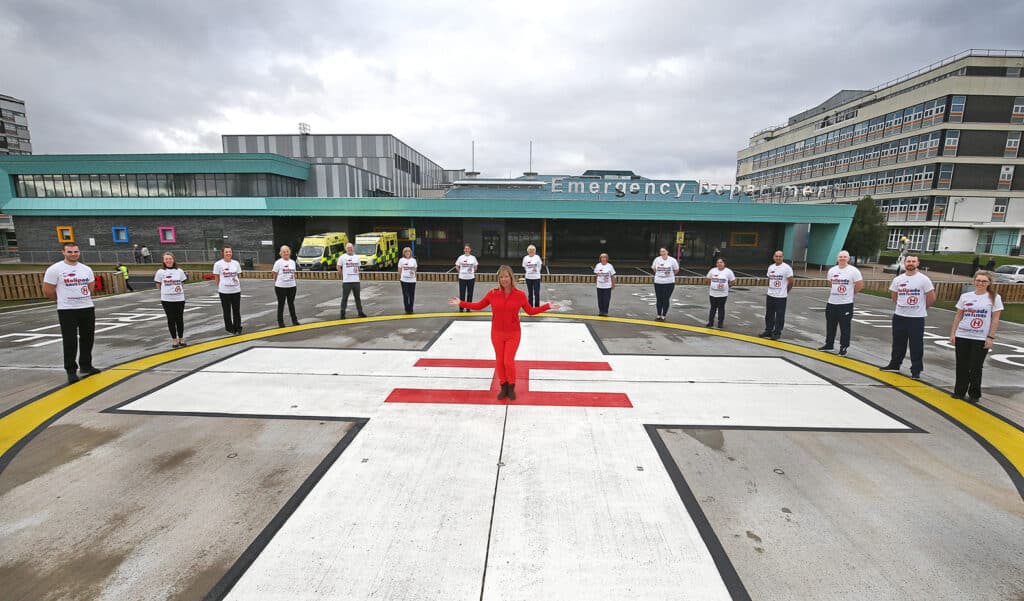
Photo: Staff with Lesley Obee from the HELP Appeal standing on Aintree University Hospital helipad
The success of the Trauma Network and Systems is reinforced by Professor Chris Moran, at the time the National Clinical Director for NHS England who instigated many of these changes:
“The development of the Major Trauma System in England has been a great success and patients are now much more likely to survive severe accidents .A key to the success has been improvements in pre-hospital care allowing advanced medical care at the accident site, accurate triage and then rapid transport to the appropriate emergency department where the patient can be received by the Trauma Team .The NHS has received a huge amount from charities, especially in the provision of Air Ambulance Helicopters, helipads at Major Trauma Centres and the provision of Critical care cars when helicopters cannot fly. These have saved many lives.”
The HELP Appeal has not only played a significant part in making the new systems of care work by the provision of helipads and critical care cars but it has also funded sophisticated training equipment including, as an example high fidelity mannequins to teach resuscitative thoracotomy- the procedure of opening the chest and stitching holes in the heart as part of the management of chest stab wound.
Rob Bentley, National Clinical Director for the National Major Trauma System has this to say about the HELP Appeal:
“I would like to take this opportunity to congratulate the HELP Appeal on reaching their 15th Anniversary. The HELP Appeal through providing its support for Hospital Emergency Landing Pads has made possible the time critical transfer of more than 30,000 patients many suffering from the most life threatening and changing injuries. This has undoubtedly saved many lives and helped reduce the effects of life long disability by allowing the rapid intervention of hospital specialist teams in the most timely manner.
“There are times in life when people say we couldn’t have done it without you, but as in this case its absolutely true and you should be extremely proud that your charity is one that saves lives and we will never forget it.”

Professor Sir Keith Porter,
Emeritus Professor of Clinical Traumatology, University of Birmingham